
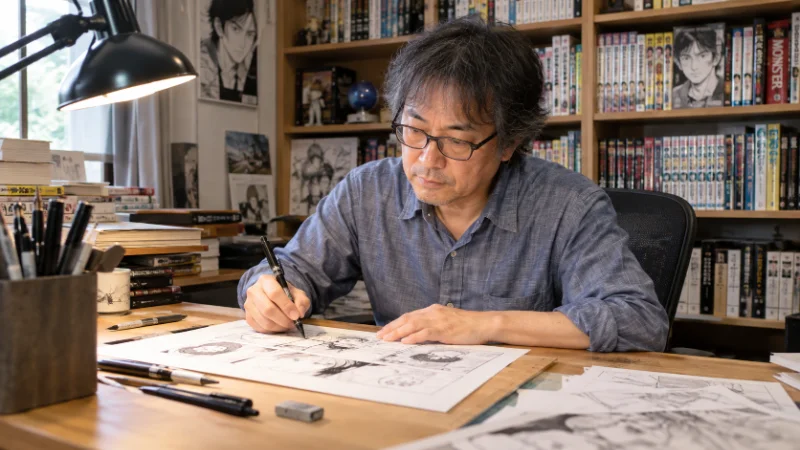
Naoki Urasawa draws his stories the way other people write diaries: daily, by instinct, without knowing the ending until he gets there. Over four decades he has built some of the most acclaimed manga in the medium’s history, including Monster, 20th Century Boys, and Pluto, and he has done it almost entirely without a script written in advance. That working method, as much as the stories themselves, is what separates him from nearly everyone else drawing manga today.
| Category | Details |
|---|---|
| Full Name | Naoki Urasawa (浦沢直樹) |
| Born | January 2, 1960, in Fuchu, Tokyo, Japan |
| Nationality | Japanese |
| Occupation | Manga artist, musician, TV and radio host |
| Education | Meisei University, degree in economics |
| Professional Debut | 1983, with the short story Beta |
| Years Active | 1983 to present |
| Notable Works | Yawara!, Master Keaton, Monster, 20th Century Boys, Pluto, Billy Bat, Asadora! |
| Frequent Collaborator | Editor and co-writer Takashi Nagasaki |
| Major Awards | Shogakukan Manga Award (three times), Tezuka Osamu Cultural Prize (twice), Kodansha Manga Award, and multiple Eisner Awards |
| Copies Sold Worldwide | More than 140 million as of December 2021 |
An Economics Degree He Never Planned to Use
Urasawa was born on January 2, 1960, in Fuchu, a city in the Tokyo metropolitan area. He started drawing manga around age four, inspired by Osamu Tezuka’s Astro Boy, and by eight he had already finished his first complete story. Even as a child, he could tell the difference between manga made with real craft and manga drawn only to sell.
That instinct almost kept him out of the industry entirely. Urasawa never planned to become a professional artist, and he graduated from Meisei University with a degree in economics instead of an art credential. He only brought samples of his manga to an interview at publisher Shogakukan out of curiosity while applying for a business job. An editor happened to see the work, redirected him to the right department, and Urasawa entered Shogakukan’s 1982 New Manga Artist Award with an unpublished piece called Return. He won.
Breaking In: From Pineapple Army to Yawara!
Urasawa made his professional debut in 1983 with a short story called Beta, published in a special issue of Golgo 13. His first major serialized project came in 1985, when he illustrated the action series Pineapple Army, written by Kazuya Kudo, for Big Comic Original.
While that series was still running, Urasawa launched the manga he both wrote and drew himself for the first time: Yawara!, a judo series that began in 1986. It became his first hit, spawning a live-action film and an anime adaptation the same year it ended in 1993, and it earned him his first Shogakukan Manga Award in 1989. The success proved something the young Urasawa needed to prove to himself: that a story he actually wanted to tell could also sell.
Two Deadlines at Once: Master Keaton and Happy!
For most of his career, Urasawa kept two series running in parallel, one weekly and one semimonthly, which meant six deadlines a month with almost no days off outside of sleeping and eating. The pattern started when Yawara! was still airing. In 1988 he began Master Keaton, an adventure series he illustrated for writers Hokusei Katsushika and Takashi Nagasaki, the editor who would become his longtime creative partner.
When Yawara! wrapped in 1993, Urasawa immediately started the sports manga Happy!, which ran until 1999. Neither series matched what came next, but together they built the discipline and the working relationships that made his next decade possible.
Monster: The Series That Went Global
Urasawa began Monster in December 1994, a psychological thriller about a Japanese surgeon hunting a former patient who grew up to become a serial killer. It was the first of his works to find real acclaim outside Japan, and it won him the 1999 Tezuka Osamu Cultural Prize along with a second Shogakukan Manga Award in 2001. Pulitzer Prize winner Junot Diaz later called Urasawa a national treasure in Japan after reading it.
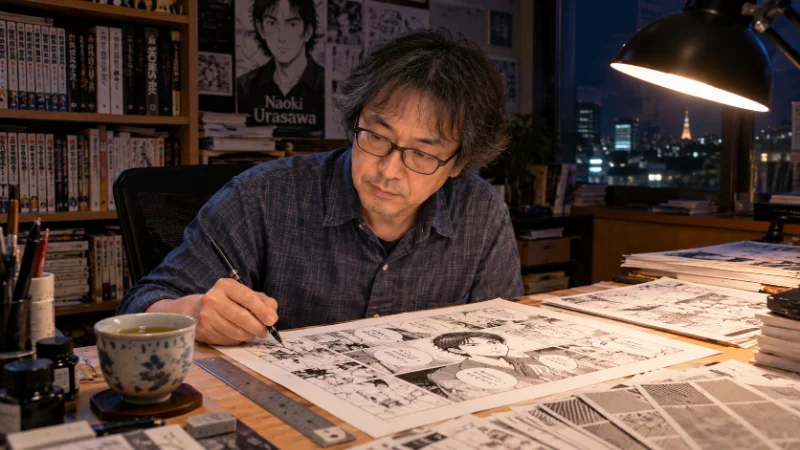
Monster is the clearest example of how Urasawa’s style had shifted. His earlier work, including Yawara!, leaned toward lighter entertainment, but critics and fellow artists have pointed to Monster as the moment his layouts became more cinematic and his character work more psychologically exact. Manga scholar Fusanosuke Natsume noted that Urasawa’s panel structure by this point resembled film storyboarding more than traditional comics pacing.
20th Century Boys and Pluto: Two Series, Two Legacies
When Happy! ended, Urasawa started 20th Century Boys in 1999, a science fiction mystery about a group of childhood friends confronting a cult leader who is turning their old games into real catastrophes. It ran until 2006, picked up the 2001 Kodansha Manga Award and a third Shogakukan Manga Award, and was adapted into a trilogy of live-action films released in 2008 and 2009.
While still working on that series, Urasawa took on a project few artists would attempt: reimagining a story arc from Tezuka’s own Astro Boy. The result, Pluto, ran from 2003 to 2009 and won him a second Tezuka Osamu Cultural Prize, an honor that carries particular weight given that it comes from the family and legacy of the artist he was reinterpreting. Pluto also won the Association des Critiques et des journalistes de Bande Dessinée’s Prix Asie in 2010 and an Angouleme Intergenerational Award in 2011, and it remains one of the most widely recommended entry points into his work for new readers.
Billy Bat, Asadora!, and What Came After
In 2008 Urasawa moved to publisher Kodansha for Billy Bat, a mystery series co-written with Nagasaki that ran through 2016 and won the Max and Moritz Prize for Best International Comic in 2014. After a short Master Keaton sequel and a Louvre Museum collaboration called Mujirushi, Urasawa began Asadora! in 2018, a series still running today. Filmmaker Bong Joon-ho has called Urasawa the greatest storyteller of his generation, and compared the experience of reading Asadora! to rediscovering 20th Century Boys for the first time.
By December 2021, Urasawa’s combined body of work had sold more than 140 million copies worldwide, a figure that places him among the best-selling manga artists ever published.
How Urasawa Actually Writes a Story
Ask Urasawa how he plans a series and the answer will surprise anyone expecting an outline. He has said he starts by imagining a movie trailer for the story in his head, and once that trailer excites him enough, he figures out where the first chapter should begin. From there, he does not plan the plot in advance. He has described the story as telling him where it wants to go, and if it stops surprising him, he cannot keep drawing it.
The same instinct governs his page layouts. Urasawa does not plan panel structure ahead of time either. He compares the rhythm of a page, when to linger on a small character beat and when to jump to a two-page spread, to breathing: something he simply feels rather than calculates. After five decades at the drafting table, that instinct has become his signature.
The Musician and Broadcaster Behind the Manga
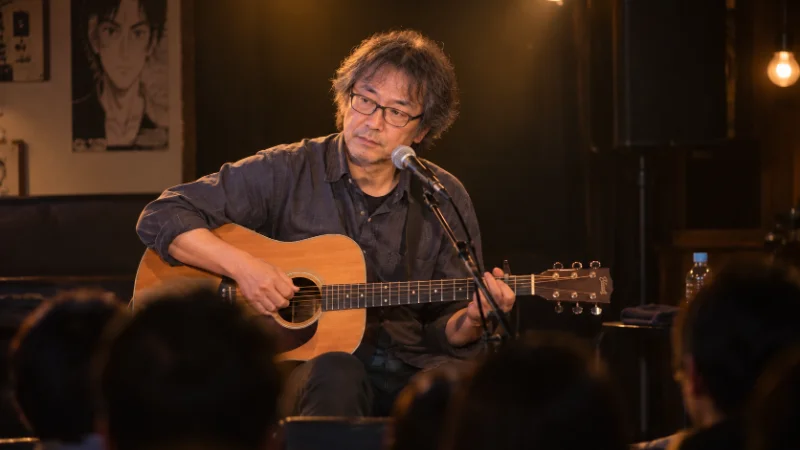
Urasawa has said that manga artists and rock musicians often wrestle with the same choice of career, and he never fully picked one. He started playing guitar in junior high, inspired by folk singer Bob Dylan, and released his debut album, Hanseiki no Otoko, in 2008. A second album followed in 2016, and a third, Love Songs, arrived in February 2025, featuring a track built around the theme song from Asadora!.
He is also the host of Urasawa Naoki no Manben, an NHK Educational TV documentary series in which he sits down with a different manga artist each episode to study how they actually draw. The show has run in various seasons since 2014 and won a Grand Prize at the 2022 Japan Media Arts Festival for an episode on artist Yoshikazu Yasuhiko. Since 2017 he has also co-hosted a weekly radio program, Junji and Naoki, on Nippon Cultural Broadcasting.
Awards and International Recognition
Urasawa has won the Shogakukan Manga Award three times, the Tezuka Osamu Cultural Prize twice, and the Kodansha Manga Award once, an unusually broad sweep across Japan’s major manga honors. Internationally, he has won multiple Eisner Awards for Pluto and 20th Century Boys, along with the Angouleme International Comics Festival’s Prize for a Series in 2004 and a Fauve Special Award in 2018. In 2022 the Max and Moritz Prize jury in Germany gave him a Lifetime Achievement Award.
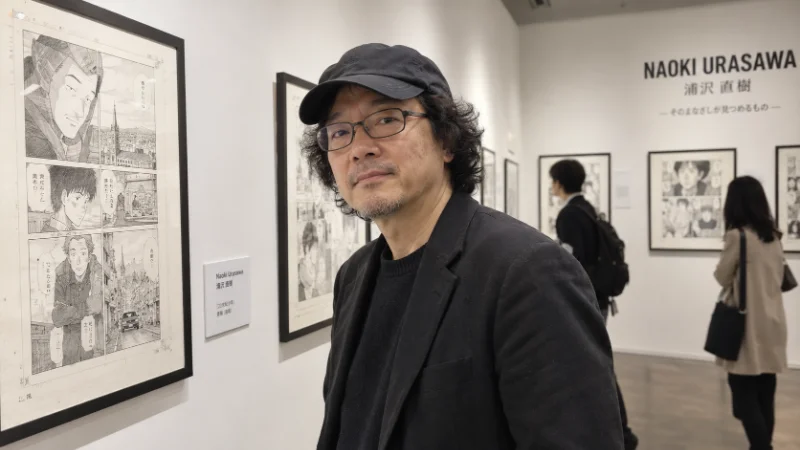
His work has also traveled well beyond the page. A 2019 exhibition of his original drawings and storyboards, titled This is MANGA, opened at Japan House Los Angeles before moving to Japan House London, giving American and European audiences a rare look at his unfinished process pages rather than just the printed result.
Why Urasawa’s Work Still Matters
Manga has no shortage of artists who found one winning formula and repeated it. Urasawa’s career reads differently. He has moved between judo, adventure, sports, psychological thriller, science fiction, and a tribute to the medium’s founding father, and he has done it while refusing to work from a fixed script. Editor Kazuhiko Torishima has called him the true successor to Tezuka, largely because of how precisely he structures a page, a skill that came from instinct rather than formal art training.
What makes his catalog worth returning to is not just the twists in Monster or the scale of 20th Century Boys. It is that each series was built the same uncertain way, one chapter at a time, by an artist who still does not know where a story is going until he gets there. That is a difficult way to build a four-decade career. Urasawa has done it twice over, in manga and in music, and he is still doing it in Asadora! today.