

Douglas Fairbanks was the man who taught American movies how to jump, swing, and grin through danger. Decades before Indiana Jones cracked a whip or Zorro carved a Z into a wall, Fairbanks was doing his own stunts on camera, and audiences could not get enough of him.
Between 1915 and 1934 he built a career that moved from light Broadway comedy to some of the most influential adventure films ever made, including The Mark of Zorro, Robin Hood, and The Thief of Bagdad. He also helped build the business of Hollywood itself, co-founding United Artists and the organization that now hands out the Oscars. His story is less about a single great performance and more about how one restless, athletic showman shaped what movie stardom would look like for the next hundred years.
| Category | Details |
|---|---|
| Full Name | Douglas Elton Thomas Ullman |
| Known As | Douglas Fairbanks (Douglas Fairbanks Sr.) |
| Born | May 23, 1883, Denver, Colorado |
| Died | December 12, 1939 (age 56), Santa Monica, California |
| Occupation | Actor, screenwriter, producer |
| Years Active | 1902 to 1934 |
| Known For | The Mark of Zorro, Robin Hood, The Thief of Bagdad |
| Spouses | Anna Beth Sully (1907–1919), Mary Pickford (1920–1936), Sylvia Ashley (1936–1939) |
| Children | Douglas Fairbanks Jr. |
| Notable Roles | Co-founder of United Artists; founding president of the Academy of Motion Picture Arts and Sciences; host of the first Academy Awards |
A Denver Childhood Built on Reinvention
Fairbanks was born Douglas Elton Thomas Ullman on May 23, 1883, in Denver, Colorado. His father, Hezekiah Charles Ullman, was an attorney who had served with the Union Army, and his mother, Ella Adelaide Marsh, came from a Southern family with roots in Louisiana and Georgia.
When Douglas was about five years old, his father abandoned the family. His mother responded by dropping the Ullman name and giving her sons the surname of her first husband, Fairbanks, along with a story that softened the family’s actual history. That early habit of shaping his own narrative would follow Douglas for the rest of his life.
Fairbanks’ paternal grandparents were German Jewish immigrants, a detail his mother reportedly kept quiet after the family adopted the Fairbanks name. Her side of the family traced back to the British Isles, with Southern roots in Louisiana and Georgia, giving young Douglas a mixed heritage that rarely came up in the fan magazine profiles written about him later.
He started performing in amateur theater in Denver at age 12 while attending the Colorado School of Mines. In 1900, the family moved to New York, where he briefly studied at Harvard, worked on a cattle freighter, took a job in a hardware store, and even clerked on Wall Street before theater pulled him back in. That string of odd jobs gave him a practical streak that stayed with him once he started running his own production company.
Building a Name on Broadway
Fairbanks made his Broadway debut in 1902 in a play called Her Lord and Master. Five years later, at the height of a promising stage career, he married Anna Beth Sully, the daughter of a wealthy industrialist, and briefly left acting to work for his father-in-law’s soap company.
When the company went bankrupt in 1908, Fairbanks returned to the stage, and it turned out to be the best thing that could have happened to him. By 1914 he had become one of Broadway’s most popular light comedy leads, known for playing cheerful, energetic young men who solved their problems through sheer nerve rather than brooding.
That same restless energy, paired with genuine athletic skill, made him an unusually physical stage actor. He rarely stood still during a scene, favoring quick footwork and small acrobatic flourishes that audiences found refreshing next to the stiffer acting style common at the time. Producers in the young film business in California took notice.
Arriving in Hollywood and Finding His Footing
In 1915, Fairbanks signed with Triangle Pictures and moved to Los Angeles. His first film, The Lamb, was directed by D.W. Griffith, who reportedly had little enthusiasm for the deal at first. The gamble paid off almost immediately.
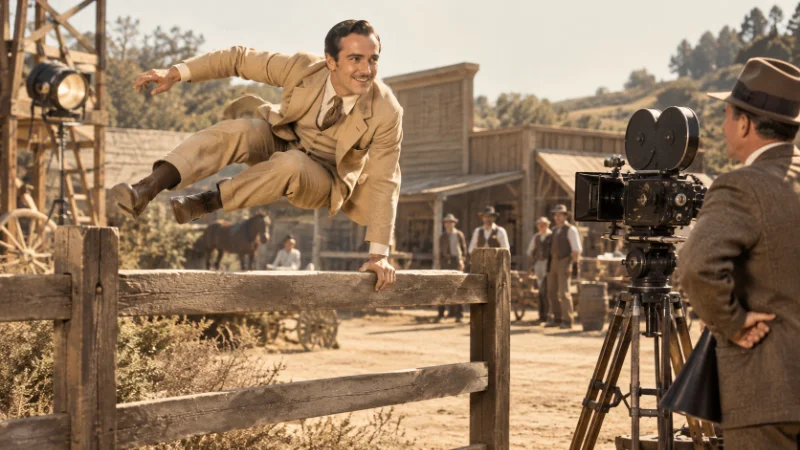
Early hits such as His Picture in the Papers and The Good Bad Man built on the same charm that had worked on Broadway: an upbeat, athletic hero who treated obstacles as an invitation to leap over them. Within a year, Fairbanks was popular and bankable enough to form his own production company, the Douglas Fairbanks Film Corporation, giving him control over his own material at a point in his career when most actors were still following studio orders.
The Turn to Swashbucklers
For his first several years in film, Fairbanks stuck to contemporary comedies. That changed in 1920 with The Mark of Zorro, in which he played the masked vigilante for the first time. The film reshaped his entire career and, in the process, created a genre.
Over the following decade he starred in The Three Musketeers, Robin Hood, The Thief of Bagdad, The Black Pirate, and The Iron Mask, films built around elaborate sets, historical costuming, and sword fights that Fairbanks performed largely without a stunt double. He trained constantly to maintain the fencing, gymnastics, and rope work his roles demanded, and he insisted on production values that were unusually expensive for the time, including hand-tinted color sequences in The Black Pirate.
Film historians and reviewers have long credited Fairbanks with essentially inventing the modern screen action hero. Empire’s retrospective review of The Black Pirate argues that Fairbanks set a standard for the swashbuckling genre that only Errol Flynn later matched, and even then only inconsistently.
United Artists, Pickfair, and Hollywood’s First Power Couple
Fairbanks was as sharp a businessman as he was a performer. In 1919, alongside Mary Pickford, Charlie Chaplin, and D.W. Griffith, he co-founded United Artists, a distribution company designed to let major stars control their own films instead of answering to the big studios.
That same year, while on a Liberty Bond tour promoting World War I war bonds with Chaplin, Fairbanks fell for Pickford, then the biggest female star in the world. Both were married to other people at the time. After their respective divorces, they married in March 1920 and moved into Pickfair, the Beverly Hills estate that quickly became the unofficial capital of the movie industry.
Pickfair hosted a staggering range of guests over the years, including Albert Einstein, H.G. Wells, and members of European royalty. Fairbanks and Pickford were treated less like celebrities and more like American royalty themselves, a status that helped normalize the idea of movie stars as public figures worth following off the screen as much as on it.
Founding the Academy and Hosting the First Oscars
Fairbanks did not just perform in the industry, he helped organize it. In 1927 he became a founding member and the first president of the Academy of Motion Picture Arts and Sciences. Two years later, in May 1929, he hosted the first Academy Awards ceremony, a private dinner at the Hollywood Roosevelt Hotel that ran a fraction of the length of today’s broadcast.
He was also involved in establishing the Motion Picture Relief Fund in 1921, an early effort to support industry workers facing financial hardship, and he lent his name and support to USC’s developing film program at a time when formal film education barely existed.
The Talkies Arrive and the Career Fades
The shift to sound film in the late 1920s hit Fairbanks harder than most of his peers. His athletic, largely visual style of storytelling did not translate as naturally to dialogue-driven pictures, and audience tastes were shifting toward different kinds of leading men.
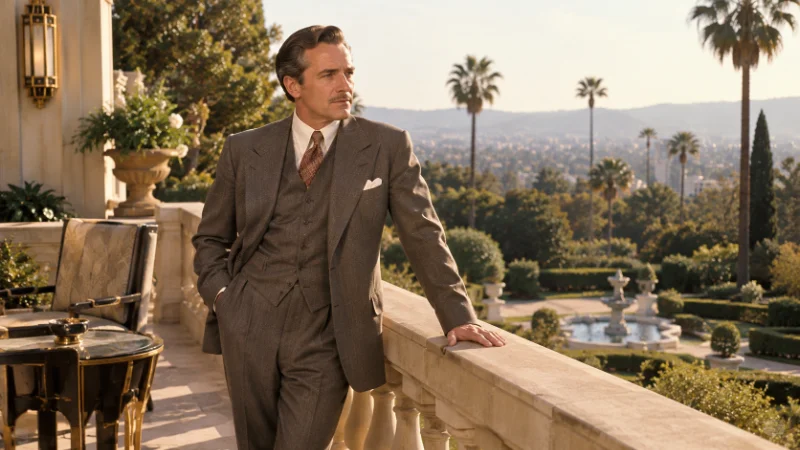
His marriage to Pickford strained at the same time his career did. The couple separated in 1933 and divorced in 1936. Fairbanks made his final film, The Private Life of Don Juan, in 1934, then largely stepped back from acting, though he stayed loosely involved with United Artists as a producer. In March 1936 he married Sylvia Ashley, a former chorus girl.
Death and Immediate Recognition
Fairbanks died of a heart attack on December 12, 1939, at his home in Santa Monica, California, at age 56. According to widely reported accounts, his last words to an assistant that morning were that he had never felt better.
Earlier that same year, the Academy had already honored him with an Academy Honorary Award recognizing his contributions to the international development of the motion picture industry, an acknowledgment that arrived while his influence was still fresh rather than after decades of distance. He was laid to rest at Hollywood Forever Cemetery, where his memorial sits at the end of a long reflecting pool, his profile rendered in brass against a white marble wall.
A Son Who Carried the Name Forward
Fairbanks’ only child, Douglas Fairbanks Jr., was born in 1909 during his father’s marriage to Anna Beth Sully. The younger Fairbanks grew up largely apart from his father, since the two spent much of the boy’s childhood on different coasts, but he still ended up following him into acting.
By the late 1930s and 1940s, Douglas Fairbanks Jr. had built his own career playing debonair leading men, roles that echoed his father’s charm without directly copying his athletic swashbuckling style. He later moved into television production in Britain and international business, and he served as a decorated naval officer during World War II, giving the Fairbanks name a second act well beyond the silent era.
Why Douglas Fairbanks Still Matters
It is easy to watch a modern action film and never think about Fairbanks, which is exactly the point. He established the template: a physically capable hero, a sense of humor even in danger, and a willingness to make the stunt work part of the spectacle itself. Later stars from Errol Flynn to Jean Dujardin, whose Oscar-winning role in The Artist drew directly on Fairbanks, have worked in the shadow of that template.
Beyond the screen, his business instincts changed how power operated in Hollywood. United Artists gave performers a path to ownership over their own work, an idea that would eventually reshape how stars and studios negotiated for the rest of the twentieth century. His role in founding the Academy gave the industry a formal body for recognizing its own achievements, one that still exists nearly a century later.
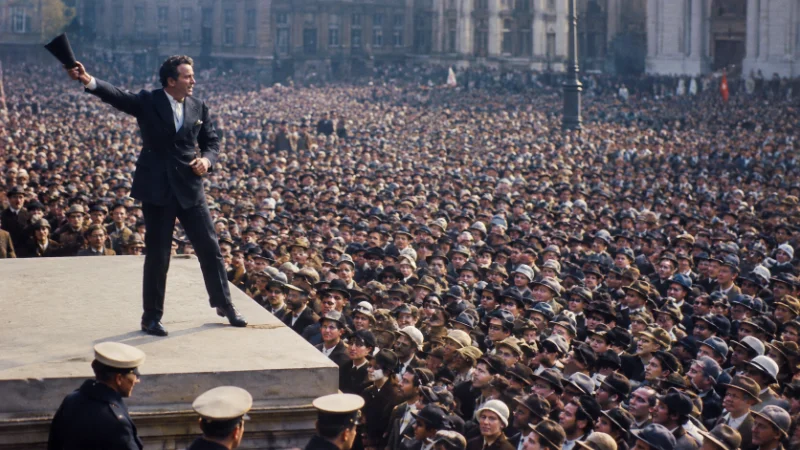
His films also hold up as physical performance in a way many silent movies do not. Because Fairbanks did the bulk of his own stunt work, the fights, climbs, and leaps in films like The Thief of Bagdad still read as genuine athletic feats rather than editing tricks, which is part of why archivists and film festivals continue to screen them for new audiences today. Even the layout of Beverly Hills owes something to him. Fairbanks and Pickford’s decision to build Pickfair on what was then undeveloped scrubland helped turn the area into the kind of exclusive residential neighborhood that other stars soon wanted to imitate.
Fairbanks was, in the end, not just an actor who happened to become famous. He was someone who treated stardom as a project to be built deliberately, on screen and off, and much of the architecture he built is still standing.